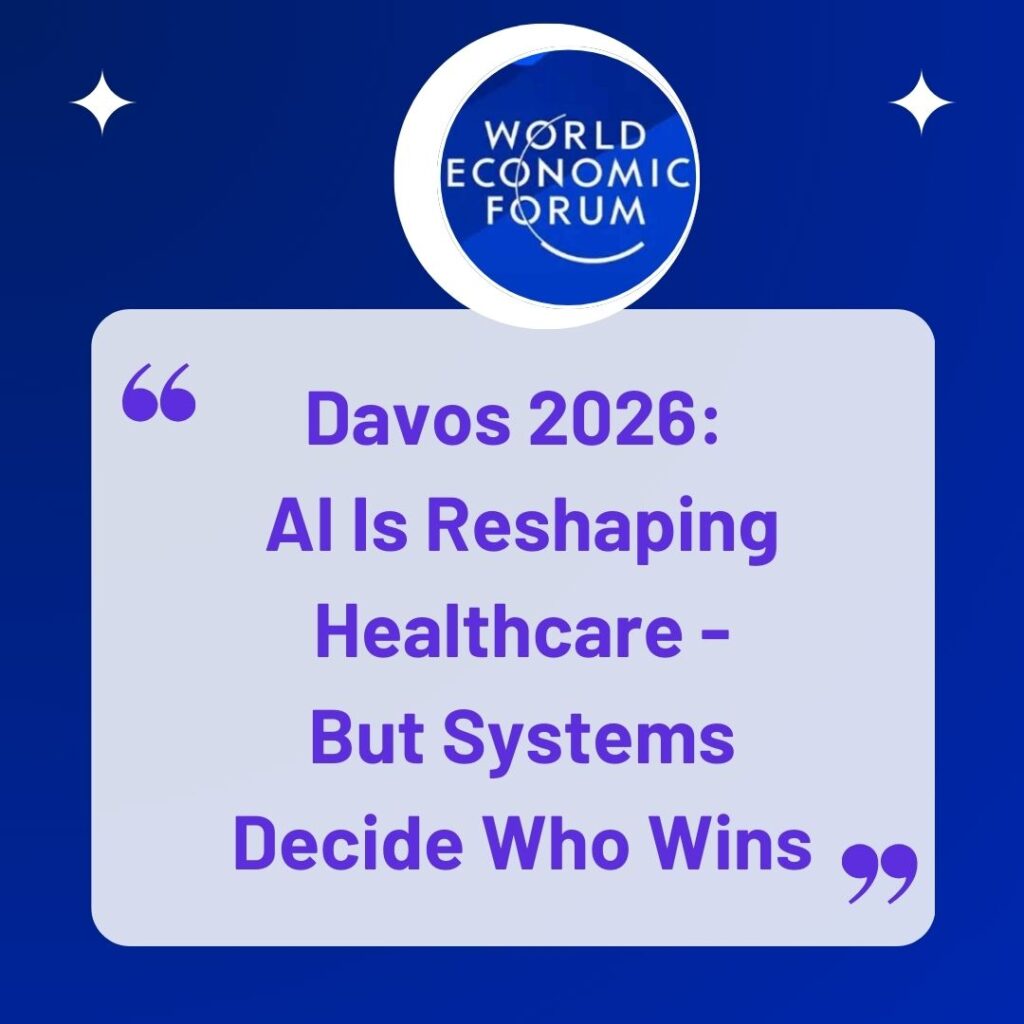
Davos 2026 put a spotlight on something that has quietly been unfolding across healthcare: AI isn’t just a tool it’s reconfiguring the very operating systems of healthcare delivery, growth, and trust.
In regulated environments, the real value of AI isn’t in flashy demos or isolated use cases. It’s in the systems that connect AI driven intelligence into decision loops, where trust, patient intent, compliance, and outcomes can be measured and acted on — not just analyzed.
Here’s the pattern I’m seeing:
AI as a signal layer
AI amplifies insight velocity but only if the underlying systems can absorb, interpret, and convert signals into governance-ready decisions.
AI as a trust engine
In healthcare and regulated markets, trust isn’t optional. AI must reinforce credibility and safety signals not just optimize cost or clicks.
AI as a scaling lens
AI can scale capacity but if execution scales before structure, risk compounds faster than insight accrues.
This is why so many growth failures happen:
- This is why so many growth failures happen:
- Effort increases but systems remain fragmented
- Speed outpaces readiness
- Channel outputs aren’t connected to governance and patient safety
The organizations that will win in 2026 aren’t those with the most AI tools — they’re the ones that build AI-ready growth systems:
- systems that align trust to demand,
- data to decisions,
- and automation to regulatory clarity.
For healthcare and wellness brands, that means moving AI discussion from what it can do to how it plugs into your core operating system.
The real frontier isn’t AI alone — it’s AI embedded in connected growth and market readiness systems.
If growth is a system, AI must be part of the architecture — not an isolated add-on.