One thing I’ve noticed recently is that many small businesses are approaching AI the wrong way.
They are asking: “How can AI replace work?”
A better question might be: “Where is unnecessary work slowing us down?”
Most growing businesses don’t struggle because people aren’t working hard enough. They struggle because valuable time gets consumed by repetitive tasks, scattered information, manual reporting, endless emails, and administrative work that adds little value.
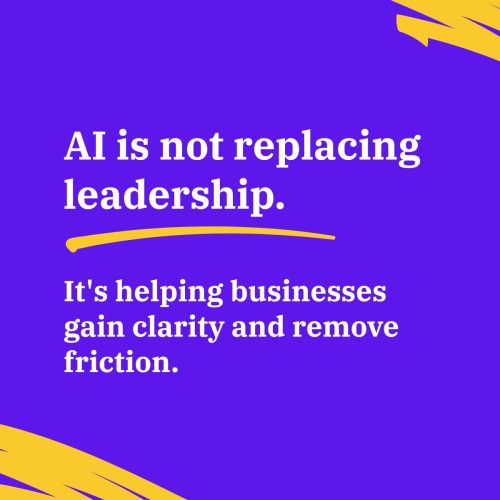
This is where AI is starting to make a real difference. Not because it replaces people but because it removes friction.
- Meeting notes can be summarized automatically.
- Information can be found faster.
- Reports can be generated more quickly.
- Customer enquiries can be handled more efficiently.
- Tasks that previously took hours can often be completed in minutes.
For a small business, that extra capacity matters. Large organizations often have more resources, but they also carry more complexity.
Smaller businesses have always competed through speed, adaptability, and close customer relationships. AI can strengthen those advantages.
What I've found most interesting is that the businesses seeing the best results are not trying to automate everything.
- They are identifying specific bottlenecks and solving them one at a time.
- They are using AI to improve existing strengths rather than replace them.
There is also an important reality that often gets overlooked.
- AI does not fix unclear processes.
- It does not improve weak decision-making.
- It does not replace leadership.
In many cases, it simply amplifies what already exists inside a business.
The businesses benefiting most from AI are usually the ones that already understand how they operate and where time is being lost.
Technology can help businesses move faster but clarity, judgment, and leadership still determine where they are going.
The goal isn’t to become a larger business overnight. It’s to become a smarter one.