

Growth Intelligence

knowing what is driving growth, where opportunities are being lost, and what to do next.

AI is not replacing leadership. It’s helping businesses gain clarity and remove friction.

One thing I’ve noticed recently is that many small businesses are approaching AI the wrong way. They are asking: “How can AI replace work?” A better question might be: “Where is unnecessary work slowing us down?” Most growing businesses don’t struggle because people aren’t working hard enough. They struggle because valuable time gets consumed by […]

AI is not replacing leadership. It’s helping businesses gain clarity and remove friction. Read Post »

Executive Insights

Where Does Client Acquisition Oversight Sit in a Working System?

In most acquisition setups: Agencies handle execution. Teams support internally. Leadership drives direction. But one layer is often missing, the one responsible for coherence. Not running campaigns. Not replacing vendors. But ensuring: Alignment across efforts Visibility across outcomes Clarity in decisions This layer doesn’t add complexity.It reduces it. Because growth doesn’t break suddenly. It becomes

Where Does Client Acquisition Oversight Sit in a Working System? Read Post »

Executive Insights

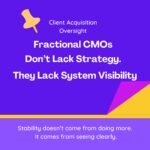
Fractional CMOs Don’t Lack Strategy. They Lack System Visibility.

Fractional CMOs often operate across multiple vendors, channels, and teams. Strategy is clear. Execution is active. But visibility? Fragmented. Each vendor reports differently. Each channel optimizes in isolation. No single view reflects the full system. This creates a hidden risk: Decisions are made on partial signals. Over time, this leads to: Slower decisions Conflicting directions

Fractional CMOs Don’t Lack Strategy. They Lack System Visibility. Read Post »

Executive Insights

Agencies Don’t Lose Clients Due to Effort. They Lose Them Due to Unclear Narratives

Most agencies don’t lose accounts because teams aren’t working hard.  They lose them when the client stops understanding what’s happening. Campaigns may be running well. Leads may be coming in. But if the client asks: “Why is this working?” “What should we do next?” …and the answer isn’t clear—confidence drops. That’s when reporting becomes defensive.Calls

Agencies Don’t Lose Clients Due to Effort. They Lose Them Due to Unclear Narratives Read Post »

Executive Insights

When Client Acquisition Feels Unstable, Execution Is Rarely the Problem

You don’t lose control of client acquisition because teams aren’t working hard.You lose control when multiple efforts start moving without a unifying structure. Across healthcare and regulated markets, most organizations already have capable agencies, internal teams, and tools in place. Campaigns are live. Budgets are allocated. Reports are shared. Yet over time, a familiar pattern

When Client Acquisition Feels Unstable, Execution Is Rarely the Problem Read Post »

Executive Insights

Client Acquisition Stabilization: Why Healthcare Businesses Need Stability Before Growth

Many healthcare businesses generate enquiries consistently. Yet revenue does not feel consistent. One month performs well. The next month slows down. Ad budgets remain similar. Lead volume appears steady. Still, cash flow fluctuates. This is where the real issue begins.It is not always a marketing problem.It is often a stabilization problem. Many healthcare businesses generate

Client Acquisition Stabilization: Why Healthcare Businesses Need Stability Before Growth Read Post »

Executive Insights

BioAsia 2026 Hyderabad — Why Digital Growth & Market Expansion Architecture Now Determines Who Scales

In an era defined by regulatory tightening, capital discipline, geopolitical health shifts, and digital acceleration, innovation alone no longer guarantees scale. Healthcare organizations today are not struggling with science.They are struggling with structural growth clarity. BioAsia 2026 represents more than a global gathering of biopharma, medtech, digital health, and AI leaders. The Real Expansion Problem

BioAsia 2026 Hyderabad — Why Digital Growth & Market Expansion Architecture Now Determines Who Scales Read Post »

Executive Insights

Why Regulated Industries Cannot Afford Marketing Chaos

Regulated industries operate under: Compliance constraints Authority expectations High trust sensitivity Irreversible capital decisions Yet many scale using generic digital marketing frameworks. This creates: Fragmented positioning Conflicting messaging Data without governance Budget expansion without margin clarity A Growth Architect aligns: Trust structure Acquisition channels Margin-weighted strategy Expansion sequencing Governance frameworks When regulation increases, architecture matters

Why Regulated Industries Cannot Afford Marketing Chaos Read Post »

Executive Insights

Google Ads Doesn’t Fail at Execution, It Fails at Governance

When companies hire a digital agency to run Google Ads, they rarely hand over a blank check and walk away. Before a single campaign goes live, there’s an upstream layer that determines whether execution is even safe: What success actually means Which signals can be trusted How much risk is acceptable When humans step in

Google Ads Doesn’t Fail at Execution, It Fails at Governance Read Post »

Executive Insights

The New M&A Reality in Healthtech: Buyers Aren’t Paying for Growth. They’re Paying for Predictability.

Healthtech M & A is often described as a slowdown, a consolidation phase, or a reset. That framing misses the real shift.Buyers haven’t disappeared. What’s disappeared is patience for ambiguity. Across recent transactions in mental health and digital health more broadly, a consistent pattern is emerging: acquirers are underwriting workflow control, integration reality, and economic

The New M&A Reality in Healthtech: Buyers Aren’t Paying for Growth. They’re Paying for Predictability. Read Post »

Executive Insights
Scroll to Top